
About the study:
Nowruz, the Persian New Year marking the spring equinox, has been celebrated for more than three millennia across regions of Central and Western Asia. Today it is observed by more than 300 million people across different regions, including diaspora throughout western countries. While extensive scholarship has examined the historical and cultural roots of Nowruz in its countries of origin, comparatively little research has explored how the festival is practiced and transformed within immigrant communities in Western societies.
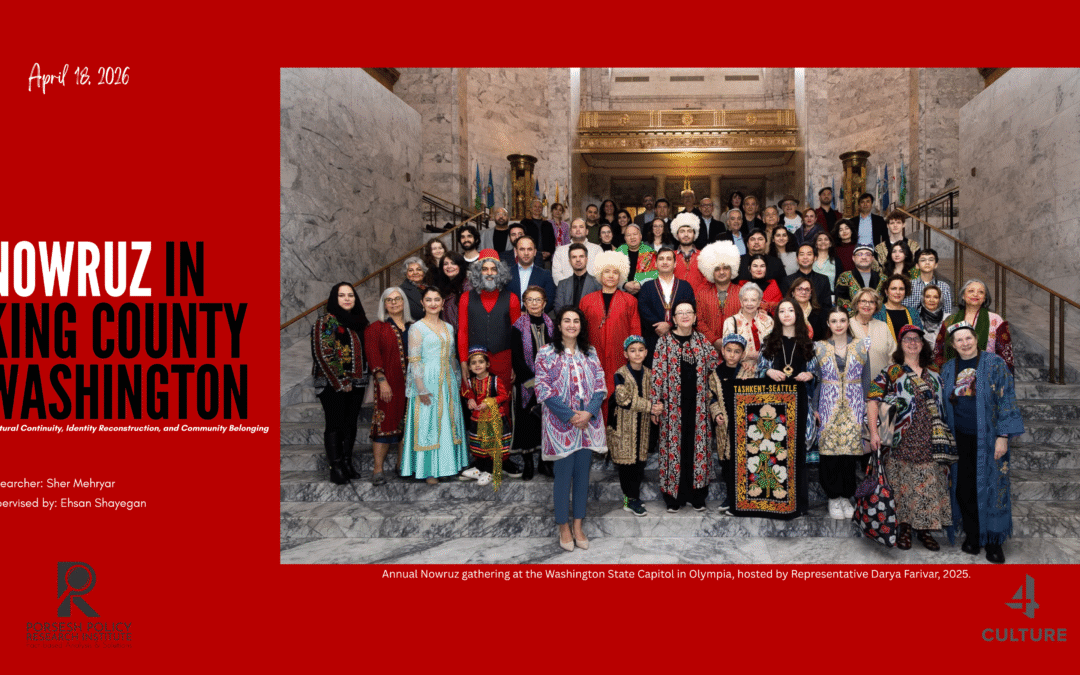
This qualitative research examines the meaning and practice of Nowruz among diaspora communities in King County, Washington. Drawing on in-depth interviews with community leaders, cultural organizers, and scholars, as well as survey responses from community participants, the study investigates how Nowruz functions as a cultural anchor in the diaspora communities. The research explores how the celebration contributes to identity preservation, intergenerational cultural transmission, community cohesion, and intercultural dialogue within a multicultural urban environment.
The findings suggest that Nowruz operates as a powerful site of cultural memory and identity reconstruction in diaspora. Participants describe the festival as an emotional renewal, a means of reconnecting with homeland traditions, and a platform for building community among diverse immigrant groups. Public celebrations organized in civic and public institutions—such as libraries, schools, and city halls—also position Nowruz as a form of cultural diplomacy that promotes cross-cultural understanding.
The study concludes that Nowruz in diaspora is not merely a preserved tradition but an evolving cultural practice that adapts to new social contexts while maintaining core symbolic meanings of renewal, hope, and communal solidarity.
Click here to read the full report.
Click here to watch the video